Friday, December 10, 2010

River Of Grass

It was time to switch gears, tune back in to the National Geographic channel, and head for Everglades National Park. We didn’t have to wait long to see some serious action. The Everglades hit us with one of its best shots at Royal Palm, about 5 miles into the park. We took the Anhinga Trail, a ½ mile loop that offered one of the best opportunities to view the wildlife up close and personal. We immediately began to see the alligators, lounging in the sun, lying on top of each other, some with their mouths wide open. Part of the trail consisted of an elevated boardwalk and I felt pretty safe looking down at the alligators from above. But some of them were only 6 feet away from us as we walked along the portion of the trail that wasn’t elevated. The biggest alligators were 10 feet long and with no wall or fence or canal between us, my heart would skip a beat when I’d turn the corner and see one face to face. Yet they didn’t seem particularly interested in me; sometimes they’d open an eye, but then they’d just shut it again. We were told by a ranger that stories of alligators chasing people across parking lots at 35 miles/hour were just stories. Still, we did see an alligator move 3 feet out of the water, in about 2 seconds flat, to grab an unsuspecting bird from a branch above the water. So I tried to make sure there was someone (usually someone named Hilary) between me and the alligators when I walked past the closest ones.

We returned to the Anhinga Trail many times during our visit to the Everglades. It was the closest thing to a zoo that the Everglades had to offer and many of the birds we came to see were right there. The usual suspects along the Anhinga Trail were, of course, the anhingas, cormorant-like birds with beautiful striped patterns running down their feathers and iridescent blue rings around their eyes, They would stand on the branches of the trees and the fences along the trail and flap their wings like little capes. The other regulars were great blue herons, little blue herons, tri-colored herons, and the beautiful green herons. There were hundreds of ibises, easy to spot with their distinctive hook shaped bills. And there were so many great white herons and snowy egrets that we practically ignored them by the time we left the park.

The biggest stars in the Everglades are probably the wood storks. Put on the federal Endangered Species list in 1984 when their numbers dropped from 5000 nesting birds to only 500, they are the face of the Everglades and an indicator species whose numbers measure the success of conservation efforts. They were also regulars along the Anhinga Trail. It was fascinating to watch them wading in the shallow waters, sweeping their submerged bills from side to side. They’d sense the small fish by stirring up the mud with one foot and they’d balance themselves with grand flourishes of one wing and then the other. Photographers from all over the world were in the Everglades just to capture this show.

But the most beautiful birds we spotted on this trail were a pair of purple gallinules, gorgeous creatures full of iridescent purples and blues and greens. We only saw them once, but they performed for over an hour, and watching them move in and out of the grasses and dance across the water lilies was the highlight of my visit to the Everglades.

We couldn’t find everything we were looking for along the Anhinga Trail. Besides, it was a little on the crowded side. We were told that if we really wanted to experience the Everglades we needed to drive another 40 miles to Flamingo, at the very tip of the park and right on the shores of Florida Bay. There used to be a lodge in Flamingo, but it was beat up by Hurricane Katrina and then destroyed by Hurricane Wilma in 2005. So we would be camping again, this time in sites described as “primitive,” meaning no hot showers. That hardly fazed us at this point. But it was pretty isolated out there at the end of the continent. It was just us and the mosquitoes.

We hoped that a cold spell (which hardly seemed like a cold spell with temperatures in the 70s during the day), would mean fewer mosquitoes. And I’m sure they would have been much worse during the rainy season (May through October), when they are described in the literature as “unbearable.” Unfortunately, the ones that were there managed to find us no matter how much DEET we sprayed on ourselves. But the mosquitoes at the campground were nothing compared to the ones on some of the trails that ran along the shallow, muddy waters of the Everglades. Still, we didn’t want to miss anything…

The name of the trail - Snake Bite - should have warned us that nothing good would come from following this one. But a ranger told us that we might find flamingos on Snake Bite. He failed to mention that this trail was infamous for having more mosquitoes than anywhere else in the park. Since we were in the Everglades, this meant there were more mosquitoes on this trail than anywhere else in the world. We wore long pants, long sleeved shirts, had headaches from the DEET on our faces, necks and hands, and we were still eaten alive. Right before we turned around and bailed, there were at least 50 mosquitoes hovering around Hilary’s shirt. “Fuck the flamingos,” I said as we ran back to the car, “they’re really stupid looking birds anyway.” “Yeah,” said Hilary, “and they are not even indigenous to this fucking park.”

After watching a Key West sunset in Flamingo, we turned in for the night. I awoke at 3 a.m. to the sounds of Hilary ripping duct tape, never a good sign. Sure enough, a zipper had broken and it was now impossible to close the tent. “This is not happening. You did not just break out tent in the Everglades,” I screamed, starting to hyperventilate. We had learned earlier in the day that there were 26 kinds of snakes in the Everglades, 4 that were poisonous, and that if we walked around the campground at night we’d be able to count hundreds of pairs of eyes in the dark. We had also learned that Flamingo held the distinction of being the only place on the planet where both fresh-water alligators and salt-water crocodiles lived side by side. “No. No. No. This not happening,” I knew I was repeating myself. And I knew I was behaving like a child. But I couldn’t help it. Even in San Francisco, I hated spiders and bugs and anything that crawled. I knew I had no business camping in the Everglades. What is the world was I thinking?

As cold air started blowing through the tent, I thought about getting in the car and leaving. It would serve Hilary right for breaking the tent, I thought. But I was afraid to go alone. I’ll take Layla with me, I thought. But what if the snakes got her first? Ultimately, it was the fear of fending off snakes and mosquitoes and alligators that kept me paralyzed in the drafty tent. I took some deep breaths and my nervous breakdown began to subside. Then I started ripping pieces of duct tape and handing them to Hilary.

The next morning, we gave the ranger an earful when he made the mistake of asking us about our night. But as luck would have it, he offered us a tent that someone had left   behind (probably someone who’d had a night like ours and sworn off camping forever). Not only was it bigger than our tent and in better condition, it actually had a walk in closet. There was some sort of a lesson here that did not go unnoticed. One zipper breaks and another door opens. Or something like that.

The upside to making the trek to Flamingo was, of course, the birds. They migrate to the mudflats along Florida Bay during the dry season and, at low tide, thousands were visible from the campgrounds. They were mostly egrets and herons and white pelicans. We’d hear the thunder and turn to see fifty or more taking off or landing at the same time. And we’d never seen so many ospreys. Sometimes they flew as close as 10 feet over our heads and when they carried fish in their talons, they looked like small water planes. More exciting though, were the flocks of roseate spoonbills that we regularly saw in the trees along Mrazek Pond, about a ¼ mile up the road. Not quite as long a flamingos, but bright pink and with spoon-billed beaks, these birds were very entertaining as they flapped their beautiful wings, preened themselves, and gracefully moved from branch to branch. The trauma of the previous night was behind us, our marriage was still intact and we were already planning our next trip to the Everglades.

I had fallen in love again, this time with a “River of Grass,” the name given this landscape by conservationist Marjory Stoneman Douglas. Composed of more than 1.5 million acres, the Everglades are the largest wetlands in the United States. Water is everything here in the Everglades and problems with the quality, quantity, timing and distribution of water continue to ripple throughout the park. Everglades was the first national park created to protect a threatened ecological system. The most obvious remaining threat to the wetlands is, of course, the human population explosion (according to one statistic, 800 people a day move to Florida) with its competing demands for water. Pollutants from agriculture and other human activities only add to the problems.

The impact on the wildlife is heartbreaking, with the numbers of wading birds nesting in the Everglades declining 93% since the 1930s. But efforts to save the remaining Glades and restore a semblance of their original function are underway. Congress recently authorized the world’s largest environmental restoration project. Over a period of 30 years, the goal is to return the waters to a more natural and balanced state. One of the rangers told us he was “guardedly optimistic.” I hope his optimism is founded because there is something very special about this giant swamp. Marjorie Stoneman Douglas said it simply and perfectly: "There are no other Everglades in the world. They are, they have always been, one of the unique regions of the earth; remote, never wholly known. Nothing anywhere else is like them..." Amen.
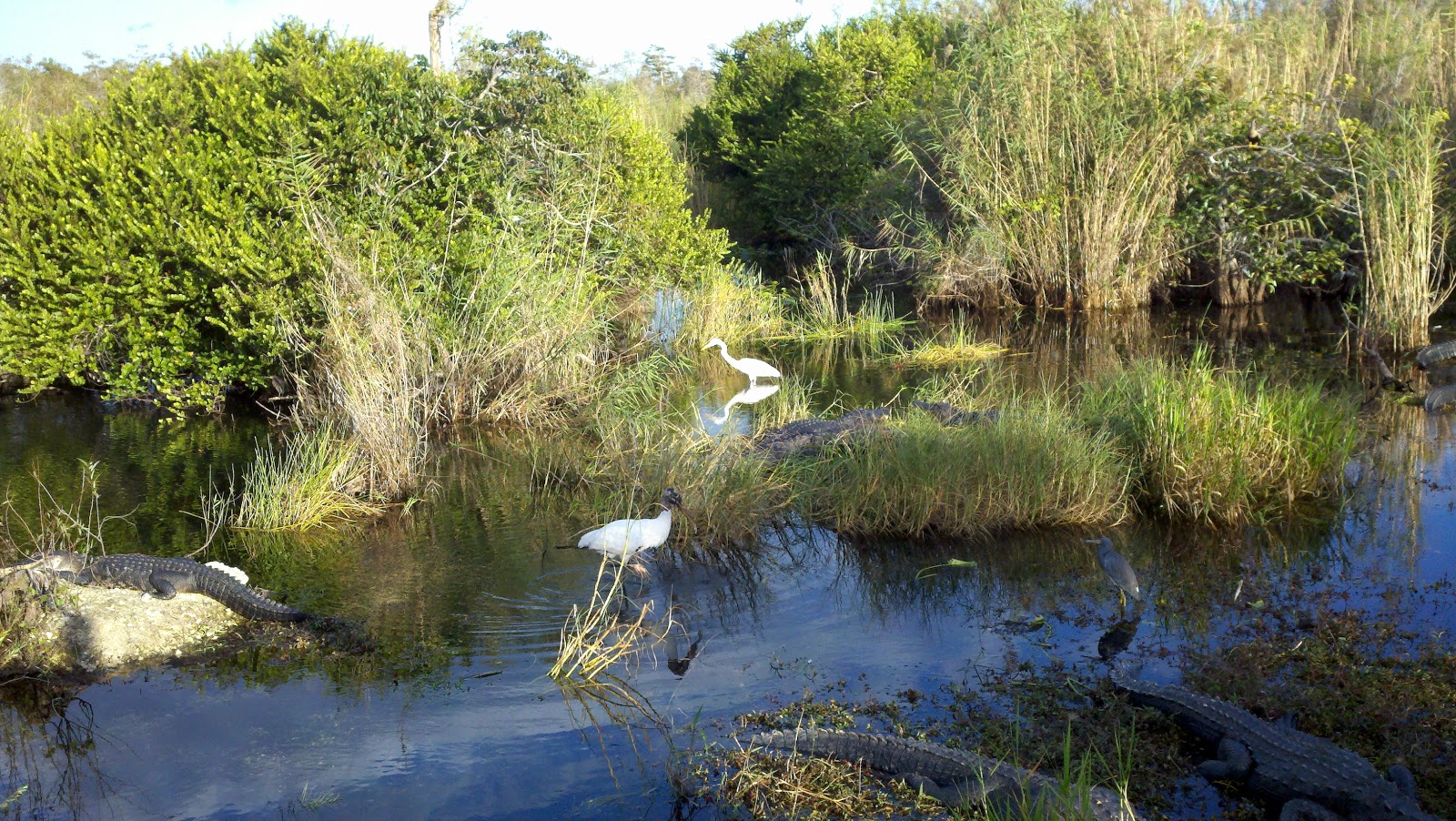
The usual suspects in the Everglades
At the best spot in the park, the Anhinga Trail
Where we saw alligators up close and personal
On the rocks
And on the move
Yikes!
That anhinga better watch out
If you look closely, you can tell this one is a crocodile
(lighter in color, narrower snout, and teeth that point up)
Great Blue Heron
Little Blue Heron
Green Heron
As close as we'll ever get to an osprey
 The Egrets
Wood stork hunting among the alligators
With a flourish
Do not, I repeat, do not ever go down this trail
Even if this guy tells you you'll find flamingos there
One of the 26 species that could have found its way into our broken tent
Our new tent: One man gathers what another man sows
Flamingo had killer sunsets
An air boat ride
On the River of Grass


Tuesday, December 7, 2010

Margaritaville

We crossed the border from Georgia into Florida and, just like that, the south was a fading memory. Gone were the southern accents, replaced by the sounds of New York and New Jersey, and as we traveled farther south, Cuba and the Caribbean. Gone too were the manners and the southern hospitality. It was back to brusqueness, I mean business, as usual in Florida. We immediately noticed an increase in the number of senior citizens behind the wheels. They cut us off in traffic, turned without signaling (or even looking) and generally endangered the lives of everyone in the Sunshine State. When the local news reported a hit and run accident and described the suspect as an elderly male, I wasn’t surprised. I doubted the police would have much luck nabbing their guy, however, if “elderly” was the only description they had to work with. And we could forget about getting an open lap lane in the swimming pools that spawned the water-aerobics craze; the old gals had their territroy staked out and they weren't about to budge. The names of the towns in Florida, names like Frostproof and Winterhaven, reminded us why they were all there. It was the same reason we were there. It's the weather, stupid.

We spent our first night in St. Augustine, the oldest city in the United States, on our way to visit relatives in Satellite Beach. Thanksgiving was still a week away, but St. Augustine was getting a jump on Christmas with a "Festival of Lights", an extravaganza that turned the perfectly picturesque historic downtown into a garish Las Vegas-like carnival. We gravitated toward the white sand beaches, then headed south where Hilary spent time visiting with his brother. Meanwhile, I got tips on proper squat technique from our niece, Loni, a personal trainer. I am going to start doing those squats tomorrow. Or the day after tomorrow for sure.

The Florida Keys are not known for their beaches as much as for their sunsets and nightlife, but Bahia Honda State Beach, just south of Marathon Key, actually made the cut on several “world’s most beautiful beach” lists. It sounded like the perfect place to camp and we felt lucky when we arrived and were told there was one remaining campsite. We set up camp and went off to look for Key Deer and the No Name Bar. The former are the endangered and very adorable miniature deer that live on Big Pine Key. The latter is a bar that’s become infamous for being especially hard to find. We found the deer on the way to the bar where we stapled a dollar bill with our names on it to the wall, as thousands before us had done.

We woke up on Thanksgiving morning grateful to be alive in paradise. “Not so fast sister” said the forces of the universe. It turns out that the ranger who checked us into the park had failed to clarify that our site was only available for one night. We would have to pack up and leave by noon. Wait a minute, What about the three day rule? Early on we decided that, given the time and trouble and aggravation of setting up a campsite, it wasn't wort the effort unless we stayed for at least 3 days.  That was our rule dammit. But it wasn’t their rule. We asked about moving to another site but were told that the whole campground was full. "Some people actually plan their Thanksgiving getaways and make reservations months in advance."  We asked about other camping options but were told not to expect better luck at any of the other State Parks either. "Some people actually plan their Thanksgiving getaways and make reservations months in advance." Okay, okay, we were getting the picture. Our lack of preparation had bitten us in the ass this time. This happens now and then on a road to nowhere. We took a final stroll on the most beautiful beach in the world. Hmmpff, I thought to myself, mediocre at best.

We decided to try our luck on the Lower Keys, where we knew there were a couple of private campgrounds.There was space on Sugarloaf Key, but only because their camground had no occupancy limitation whatsoever. Rows of RVs parked on top of each other and hundreds of people wandered around aimlessly. It felt like some sort of a refugee camp and when we saw a smoldering mattress in one of the dumpsters and buzzards swarming over the unoccupied sites, we decided to keep driving. We had come this far, we might as well go all the way to the end of the road.

When we finally arrived at Boyd’s in Key West, we probably would have settled for anything. We didn’t have to. From the palm trees, to the swimming pool, to the colorful reef fish we saw swimming along the pier, this place looked like a five star resort. We understood why it looked so nice when they told us how much they charged; at $75/ night, this was certainly the most expensive campground we had ever stayed at. But it was Thanksgiving Day and we had literally reached the end of the road and the southernmost point of the United States. Plus they had Wi-Fi and the perfect place to set up the big Thanksgiving Video Conference, coordinated with my family in advance and planned for later that night. Nearby Hogfish Bar and Grill was serving up turkey and the trimmings, so we ate dinner at an outdoor table overlooking the Marina and were back in time to set up the video conference.

My first thought when I turned on my laptop and looked at the screen was that I was having some sort of an acid flash-back. It looked like a psychedelic lava lamp. There were blues and greens and purples and something that looked like an oozing black blob around the point that looked like (gasp) a cracked windshield. Confusion turned to panic. Everything on the island was shut down for the holiday. What about the Thanksgiving video conference? And what about my blog?  I was already running behind my self imposed deadline and hadn’t posted anything in over a week. Everything looked very grim. And then the storm rolled in. The palm trees turned sideways and the rain began to pour. Several inches of rain fell that night, much of it ending up beneath our tent. The Keys were not making a very good first impression.

When we dried ourselves off the next morning, we drove into town to look for the ghost of Hemingway and a new computer screen. At first glance, Key West seemed like a parody of itself. “Margaritaville” was a tourist bar and souvenir emporium. Jimmy Buffet’s songs were played in the bars and around the pools and the lobbies of the restaurants and hotels. Drunken tourists and locals alike spilled into and out of the bars along Duval Street. This place was called “Key Waste” for good reason. The island’s substance abuse problem was even the subject of some clever tee-shirts. My favorite read: “A small drinking island with a big fishing problem.” At first it was hard to see past the crowds and the drunks and the kitsch. Yet there was more to the island than the drinking and the fishing and every day we’d say “let’s stay just one more day.”

It helped that we made friends with locals who directed us to the best spots on the island. The Keys may not be a beach destination, but Fort Zachery State Park had the best beach on the island. There were palm trees, white sand and light green water. And it was the best place on Key West to watch those famous sunsets.

We quickly learned to explore the town before and after the day trippers from the cruise ship took over. We avoided Duval Street, opting instead for the side streets where we found beautifully restored Victorian cottages, the old lighthouse and, of course, Hemmingway’s house. We took pictures at “Mile 0”, marking the end and the beginning of Hwy 1. And we checked out the giant buoy marking the southernmost point on the southernmost island. We were directed to the little places frequented by the people who lived on Key West - El Mochos for espressos, Chico's for hogfish tacos and Sandy's for Cuban sandwiches. One night we splurged on an amazing dinner at Café Sole, where we were lucky to get in without a reservation. We adjusted our clocks to Key West time, and the colors and the flavors of the Conch Republic started to soak in.  

Key West is nothing if not colorful. Along with the sunsets in the west, outperformed only by the sunrises in the east, the characters on Key West put on quite a show. There was a ZZ-Top looking guy, only really tanned and shirtless, who rode his chopper around town with a huge American Flag attached to the back and flying in the wind. Another guy, also tanned and shirtless (tanning is still a sport here in the Keys), rode a bicycle with a mailbox attached to the back that said “Somewhere in Key West.” I had a feeling he wasn’t the only one who had come to this island to get off the radar…

Some of these colorful characters called themselves street artists and performed every night at the Sunset Celebration on Mallory Square. One of the most popular acts involved a maniacal Frenchman and several cats that jumped through fiery hula-hoops. It seemed all wrong and I was tempted to let Layla off her leash just to disrupt the show. Yet he drew the biggest crowds and we were told that he earned enough money to put his daughter through Brown University. Hopefully, she’ll pay back her karmic debt by working for PETA someday. We watched another performance by someone who must be the world’s oldest tightrope walker. This guy looked like he had asthma and Parkinson’s disease and we wanted to give him money just to make him stop. But the worst of the worst was a really terrible Rod Stewart impersonator. Or maybe he was a Barry Manilow impersonator, I couldn't be sure. He was so bad that I was mesmerized and couldn’t stop watching. I finally had to be dragged away. Apparently, the weirder you are, the more likely you are to do well in Key West. A local guy told us about a new act on the circuit. She is called the “Chicken Lady” and she gets paid for letting people feed scorpions to her chickens.

And speaking of chickens, they were everywhere in Key West. The roosters were particularly beautiful and colorful and they strutted around the town as if they owned it. I commented on this to a local guy who wasn’t impressed. “They are a fucking nuisance” he shot back. “They are dirty and disgusting and they never fucking shut up.” I did recall thinking that it was a little early for roosters when I heard them one morning at 3 a.m. Then I started hearing them at 11 p.m. and at 1 a.m. and at 2 a.m. It was true: they never fucking shut up.

More disturbing than their noise, however, was the affect these birds had on Layla. She had developed some sort of homicidal blood-lust after killing the chicken in New Jersey and she would madly lunge at their necks, nearly pulling my shoulders out of their sockets. My worst fears had been realized. And she used to be such a good dog. Actually, she is still a good dog, except when she is a bad dog. And then she is very, very bad. While we were loading up the car, she managed to eat something that smelled so bad I actually washed her mouth out with Dr. Bronner’s peppermint soap. When she threw up the contents of her stomach an hour later, all over the car, we were able to determine that she had consumed all or part of a dead alien. That's what it looked like anyway. We washed her blanket and the towels at the coin laundry and then went to look for a place to have the car detailed. Such a bad dog...

Before we knew it, eight days had passed. We had gotten a little too comfortable in Key West. If we don’t leave today, I thought to myself, we might never leave at all; this island might not let us leave. Staying forever did have its appeal. But we headed for the Everglades, pretty sure we’d find colorful characters there as well.

Key West is famous for its sunsets
The sunrises were pretty impressive as well
We were asked to leave Bahia Honda on Big Pine Key (most beautiful beach? meh)
Fort Zachery on Key West was a great alternative
And our new campground, Boyds, Key West, was like a five star resort
With palm trees and a swimming pool even
Hogfish Bar and Grill
Where we had Thanksgiving dinner
Hemmingway's House
The Old Lighthouse
Mallory Square
The world's oldest tightrope walker at the Sunset Celebration
The beginning
And the end
The southernomst point
If the sign fits...
A picture is worth a thousand words
The source of a lot of aggravation for Layla
But what a beauty
Signing off from Key West
With The Conch Republic Credo


Sunday, November 28, 2010

Deep South Thoughts

By the time we arrived in Savannah, Georgia, we'd adopted cartoonish southern drawls and taken to entertaining ourselves with conversations that went something like this:
"Skeeter, honey, I reckon you done missed our turn. That rat there looks like the swimmen pool."
"I don't see nuthin Cricket."
"Look rat there."
"Rat where? That lil bitty thing? We can't swim in that; it ain't no bigger n' a biscuit."
And so on and so on.

I could listen to those southern accents forever. They ran the gamut from smooth and sophisticated to almost unintelligible. I spoke to people that sounded like Jimmy Carter and to those that sounded like characters from "Porgy and Bess," with remnants of the African Gullah dialects brought to America and spoken secretly by the slaves. I found myself engaging people in conversation a little longer than usual just to hear them talk. This was easy to do because everyone was so damned polite. At first I thought this "southern hospitality" was contrived. Some of it probably was, especially in the areas catering to tourists where waitresses actually said "y'all come back now." But it seemed genuine and the nicknames given to Savannah - Hostess City of the South, and Charleston - Best-Mannered City, were both well deserved.

We began to notice the obvious and superficial distinctions between the North and the South sometime after crossing the Mason-Dixon Line in Maryland. Originally the delineation of a land dispute between two guys named Mason and Dixon, it is now a symbol of the cultural boundary that divides the North and the South. That boundary is still very real and in many ways the deep south felt like a different country.

We woke up in Rocky Mount, North Carolina after driving most of the afternoon and evening from New Jersey through Pennsylvania, Maryland, and Virginia. The trees had changed; the vibrant colors of fall were behind us. The weather had changed too; it was 20 degrees warmer. And then there were those accents. The kids called there mothers "momma" for starters. And it was "rat" instead of "right." People were "fixen" to do this and they "reckoned" they'd do that. And the "y'alls" just picked up speed the farther south we traveled.

Savannah, Georgia was our next destination. But we got turned around outside of Santee, South Carolina when we stopped for gas and got seduced by a stray dog. She was a beauty. A little on the scrawny side, she looked like a brindled golden retriever. This girl was smart. She knew she had me at "woof" so she directed her most brazen flirtations toward Hilary and Layla. She wagged her tail and soulfully gazed into Hilary's eyes. She ran around in circles in front of Layla. Guarded at first, both were soon intoxicated by her southern charm. "Should we call her Carolina or Savannah?" I wondered out loud. What a great story for the blog, I thought to myself. Was this meant to be? What about the plan to simplify our lives?  We went back and forth - the first of many moral dilemmas presented by the South. We had reached the point where we were talking about where to find a veterinarian when a shiny red truck pulled into the station and off she ran, wagging her tail and putting on a little show for the driver as if he was Mr. Wonderful. "What a slut," I muttered under my breath. "Ingrate," sneered Hilary. Layla's eyes narrowed as she watched Carolina sashay into the sunset. I knew exactly what she was thinking: "You bitch."

We knew this was for the best, but the rejection still stung. So we soothed our hurt feelings with the best southern remedy for everything. Barbecue. Actually, we didn't need an excuse; we had been eating barbecued ribs and links and brisket once and sometimes twice a day since we arrived in North Carolina.We ate at the big popular chains like Ken and Candies and at the off the beaten path joints like our favorite, The Georgia Pig, a hole-in-the-wall run by 5'0" and 250 lb. "Aunt Jeanette" and her toothless, but obviously very well-fed, progeny. I wanted to take a picture of this group but, along with missing their teeth, this family seemed to be missing that "southern charm" gene and I was afraid that one of them might shoot me with a bazooka or a sling-shot.

The barbecue at Coasters in Santee was pretty good, but the local history lesson courtesy of our chatty waiter, Mark, was very informative. We were told that the people from this part of the world, known as the low country, were quite resilient. They have been economically depressed for decades, with many living below the poverty level, so the present economic crises is nothing new to them and they are weathering the storm pretty well. For anyone considering relocation, according to Mark, South Carolina is very affordable. He told us that decent homes could be had for 80K and that it wasn't hard to eke out a living in Santee on 20K a year. I quickly did the numbers. "Skeeter, honey, do you reckon we'd be happy in South Carolina?"

We decided to follow Mark's advice and stop in Charleston, South Carolina on our way to Savannah. I'm not sure why Charleston wasn't on our radar to begin with as it is one of the most beautiful cities I've ever seen. Both Charleston and Savannah surrendered almost immediately during the Civil War, leaving both cities looking as grand as they did in 1860. But Charleston is a much bigger city and it seemed much grander. The historic cobblestoned downtown district was much larger. There were more statues,   monuments, and cannons in the parks along the waterfront. And the mansions south of Broad Street were far more impressive than those we saw in Savannah. Charleston's reputation as the mecca for the aristocracy was apparent from the looks of those impressive antebellum mansions running for blocks and blocks in the neighborhood south of Broad Street. We were told by those in the know that a penchant for the aristocratic still lingers in this city and there is a saying that "in Atlanta, you are asked what you do, in Savannah, you are asked what you drink, and in Charleston you are asked what your mother's maiden name is." But no one asked for our credentials, and Layla held her own among the canine gentry at Battery Park at the southern tip of the city where the Ashley and Cooper Rivers meet. We wandered around the neighborhood, desperately looking for something that our waiter told us we could buy for $80,000K. "Skeet, I think he must have meant $8,000,000..."

Charleston is also a culinary destination for foodies from all over the world. We ate at the highly recommended Jestine's on Meeting St. They served the best shrimp creole I had ever tasted and they were the first restaurant we ate at in the south that didn't have Fox News blasting in the background. Lest we forget, Sean Hannity was there, in every motel lobby and in most restaurants, to remind us that we were in a very "red" section of the Bible Belt, painful in light of the recent election results. Fox News wasn't the only reminder. There were also those creepy billboards, in the shape of crosses, telling pregnant women to listen real hard for the sound of their fetuses crying "Momma, don't kill me. I'm ALIVE."

Savannah may not have had Charleston's food and culture, but there was a mysterious and sensual vibe to the city that was very unique. And that Spanish Moss... I am still dreaming of that Spanish Moss. It had this gothic fairy-tale like quality to it and it draped from the trees like trippy Halloween decorations. When the light filtered through it, especially at dusk, it had this ethereal glow that just took my breath away. It is actually a plant called an epiphyte. It grows on the branches of the oak and other trees when the temperatures are warm and the humidity is high and it flourishes in Savannah. It was particularly memorable in Forsyth Park, where "The Garden of Good and Evil" was filmed. Everyone seems to have something to say about the Spanish Moss. I've heard that it is a member of the pineapple family, that it is not toxic, that it is filled with bugs and very toxic, and that it is somehow even responsible for the east-coast bed-bug epidemic. In any event, it was very beautiful and the Spanish Moss will be indelibly linked to my memories of Savannah.

I almost forgot about another highlight of our visit to Savannah. After walking around the Colonial Cemetary, we decided to visit the museum in the Congregation Mickve Israel, the oldest Jewish synagogue in the south. We turned the corner and there was Bevis Marks staring right at us. An ancestor? Hard to be sure, but Hilary learned a lot about Bevis Marks, one of the first Jewish settlers and the founder of the synaagogue, originally called Bevis Synagogue. As for me, I finally understood my strange fascination with the "Beavis and Butthead" cartoon characters. Heh, heh, heh.

We were about 30 miles out of town when the "check engine" light came on. Shit. I guess we better go back to Savannah. After three hours of diagnostic testing, it was determined that we will probably need a new catalytic converter in order to pass smog in California. But according to our mechanic, nothing needed to be done in Georgia because "down here in the deep and dirty south, we don't give a shit about emissions and pollution and such." Probably because they all watch Fox News and don't believe in global warming..."

After spending all afternoon at the Subaru dealership, we decided to spend the night on Jekyll Island, an old cotton plantation nicknamed "Georgia's Jewel," about an hour south of Savannah. We got an additional dose of Spanish Moss, walked on the beautiful beach, and stopped by a rehabilitation center for turtles where the patients float around with little bandages and splints and eye-patches even. Aaargh. It might have been really depressing if we hadn't learned that many of the turtles recover completely and are successfully returned to the sea.

There was a lot to love about both South Carolina and Georgia. Impressive old cities with magnificent mansions, historical landmarks, and old-towns with cobblestone streets and horse drawn carriages that hearkened us back to another era. Of course I couldn't help thinking about the price that had been paid for that era. It was hard not to think about it. Plantation tours are a booming business and little trains and golf carts carry tourists through the grand manors and the refurbished slave quarters. The Savannah Cotton Exchange is now a historic monument along the Savannah River. And the Old Slave Mart Museum in Charleston was a reminder of exactly how the southern wealth was amassed. It was especially difficult to think about our country's history as we considered the deeper and more disturbing distinctions that still exist between North and South. Confederate flags flew unapologetically as soon as we got out of the cities. And active secession movements remain afoot in both South Carolina and Georgia. If the south seemed like a different country, maybe it's because there are forces still trying to make it a different country. While racial divides exist throughout the United States, it is just seems more overt in the south. At times, all of this made it feel wrong to even appreciate the beauty of Charleston, Savannah, and the south in general. Yet it's beauty couldn't be denied and, in the end, the undercurrents of something ugly were part of the southern experience.
Shopping for houses in Charleston, South Carolina
We were told we could find something in the 80K range
I guess our waiter at Coasters
wasn't talking about the houses south of Broad St.
Hilary had a brainstorm while looking at the cannons at Battery Park, Charleston
We had recently watched "Dr. Strangelove" again
Let's channel Slim Pickens
Painful reminders in Charleston
And in Savannah
Spanish Moss in Savannah
Layla in the Garden of Good and Evil, Forsyth Park, Savannah

Historic Downtown Savannah
This might explain my attraction to cartoon characters
Jekyll Island, Georgia
I needed another dose of Spanish Moss
And a trip to the turtle rehabilitation center where
we watched them treat injured turtles
And patch them up with turtle bandages
So that they could heal and return to the sea
Y'all come back now
Ya hear?
And if y'all don't like the blog, blame my ghost-writer

.